Share a little good energy.
Start with your driving day, not the biggest charger
Write down your usual daily mileage, when the vehicle gets home and when it leaves. Include days with a longer commute and whether another EV may share the parking area. Give the electrician the vehicle model and any charging equipment you already own.
Level 1 charging is slower; Level 2 can replenish the battery faster. The right choice depends on the energy you need to replace and the time available. PSE recommends an electrician's assessment before a Level 2 installation. An existing garage outlet also needs assessment for the intended charging use; its presence alone does not establish suitability.
Find out what power already reaches the garage
A light circuit, a garage subpanel and a structure with no electrical supply are different starting points. A subpanel distributes electricity; it does not create extra capacity. The electrician needs to assess both the house supply and the wiring feeding the detached building, including its condition and other loads.
Share plans for workshop equipment, heating or other changes. Ask which existing equipment can remain and why. A suitable existing supply may support the project; another property may need a different supply arrangement or additional equipment. Avoid assuming that every detached garage needs the same feeder, subpanel or service upgrade.
Gather old permits or installation records if you have them. Leave panel covers and electrical testing to the electrician.
Choose a location the charging cable can comfortably reach
Compare a garage wall, an exterior wall and a suitable pedestal location around the way you park. Include cable storage and room to reach the handle. Tesla's installation guidance, for example, calls for reaching the vehicle without cable strain and leaving space to store the cable.
Think about a second parking position and vehicles with charge ports on different sides. Do not solve a poor location by planning an extension cord across the yard or through a doorway. Follow the selected equipment's instructions; Tesla's Gen 3 Wall Connector specifically prohibits cord extension sets. A manufacturer-approved placement is part of the installation design.
Walk the route between the house and parking area
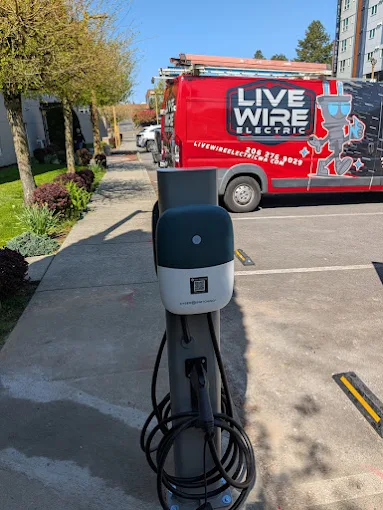
Distance matters, but so does what lies along the route. Point out driveways, retaining walls, established trees, drainage, irrigation and areas that stay wet. Ask whether existing pathways can be used and what access the crew or excavation contractor will need.
If the design requires excavation, arrange utility locating before digging and confirm the applicable process with Washington 811. Ask about privately owned underground lines too; Washington 811 provides information about private locating. Do not assume a familiar yard is clear of buried services.
Leave trench dimensions, wiring methods and inspection requirements to the project professionals. The estimate should explain who handles excavation, locates, inspection coordination, backfill and surface restoration.
Compare charging speed, load management and future needs
Ask whether a lower charging rate would meet your routine before assuming a larger electrical upgrade is necessary. Some equipment can also adjust charging around the household's other electrical use. Tesla distinguishes a fixed installer-set limit from dynamic power management that monitors available capacity using additional compatible equipment.
These features need a suitable design and correct commissioning; an app schedule alone is not the same thing. Ask what happens when other loads run and how the proposed setting affects charging time.
Discuss a future second EV, but request separate prices for today's installation and future provisions. A second charger, extra pathway capacity and a future building conversion are different projects, not one automatic reason to enlarge everything.
Match the equipment to the carport or outdoor setting
A roof over the parking space does not answer every weather question. Have the installer confirm the equipment's suitability for its exact exposure, mounting surface and connection method. Discuss water runoff, cable storage and protection from vehicle contact.
Confirm compatibility with your vehicle before purchasing. Ask whether the proposed unit is hardwired or uses a permitted receptacle arrangement, and what protection and maintenance that choice requires. For connected features, check what works without internet and whether your home network reaches the detached structure. Requirements vary by product; use the selected manufacturer's documentation rather than borrowing another charger's specifications.
Confirm the permit authority and inspection sequence
Washington L&I says electrical work generally requires a permit and inspection, with limited exceptions. When you hire an electrical contractor, the contractor must obtain the permit for its work. Some cities and Tacoma Power handle their own electrical permitting; L&I covers other locations.
Have the contractor identify the authority for your address and explain when work must remain exposed for inspection. Confirm whether utility coordination is needed for any supply changes. Ask how inspection access and an open route through the yard will be managed, rather than relying on a fixed number of visits or a promised completion date before the site is assessed.
Compare the complete project and plan the handoff
Two estimates can include the same charger while covering very different work. Request a written scope that separates equipment, electrical work, excavation, restoration and permit responsibilities. Ask which findings could change the price and how changes will be approved.
At handoff, ask for a charging demonstration, the configured charging limit, operating instructions and inspection information. Confirm how to get help if charging stops or the equipment reports a fault. Live Wire Electric can assess the route and electrical work for a detached garage or carport so the charging plan fits the property and your routine.
Helpful sources
Official guidance for a closer look.
From our crew to your home.
Live Wire Electric
We’re your Lynnwood-based electrical crew, helping homeowners understand their options and plan their next step.
Meet your local crewA good idea is better shared.