Share a little good energy.
Why battery charging is the focus of Fire Prevention Week 2026
Fire Prevention Week runs October 4–10, 2026. The National Fire Protection Association chose the theme Charge into Fire Safety: Safe Charging Is a Superpower to focus attention on charging rechargeable lithium-ion devices safely. NFPA’s October 7 announcement names phones, laptops, cordless tools, e-bikes and scooters among the devices found in everyday homes.
In Lynnwood, Everett, Bothell and surrounding Puget Sound communities, the practical question is not whether every lithium-ion battery is dangerous. It is whether the device, replacement battery, charger, electrical outlet and charging location all work together safely. A dry, uncluttered charging location is particularly important as rainy-season routines move bikes and tools inside.
This article covers the household charging setup and warning signs. It does not recommend a universal circuit size or a do-it-yourself wiring change; the equipment instructions, home wiring and applicable electrical requirements control those decisions.
Five charging habits worth checking today
A practical first review takes a few minutes. It does not require opening a panel, examining live wiring or testing a battery pack. Start with the device manual and where the household actually charges its equipment.
- Use only the charger supplied or specifically approved by the device maker. If the original is missing, ask the manufacturer for a tested replacement rather than choosing one because the connector fits.
- Choose a flat, dry, stable surface away from bedding, boxes, solvents, fuel and other flammable storage. Leave walking paths, stairs and doors clear.
- Stay home and awake during charging. Unplug the device when charging is complete; do not leave it charging through the night.
- Keep batteries and chargers within their specified temperature and weather conditions. Do not charge a wet or damaged battery.
- Check the outlet, plug and charging cable by sight. Stop if anything is damaged, discolored, loose, making noise or unusually hot, and arrange appropriate help.
Why “universal” e-bike chargers can be a problem
The U.S. Consumer Product Safety Commission warned in September 2024 that so-called universal micromobility chargers may fit a battery but still deliver incompatible charging behavior. Its warning counted 156 reported fire or thermal incidents associated with universal chargers from January 2023 through May 16, 2024. That is a historical reporting window, not a 2026 incident count.
For a missing or failed e-bike charger, contact the original manufacturer or an authorized service source and ask for the exact compatible replacement. The same caution applies to third-party battery packs and rebuilt packs. CPSC recommends using equipment certified by an accredited laboratory to the appropriate safety standards and avoiding batteries modified by unqualified people.
Certification labels matter, but they are not a guarantee of zero risk. UL 2849 covers e-bike electrical systems; UL 2272 addresses personal e-mobility devices such as many scooters. Compare the certification claim with the actual complete product and testing-lab listing instead of treating a generic UL-looking sticker on one component as proof that the whole bike is certified.
Where should a Puget Sound family charge an e-bike or power-tool battery?
NFPA advises charging larger items such as e-bikes, scooters and power tools outside when practical, while keeping exits clear. That is not permission to leave an indoor-only charger in the rain. The correct location must also satisfy the equipment maker’s weather and temperature instructions and have a safely installed power connection.
An enclosed garage may keep rain off the equipment, yet it can also contain cardboard, gasoline, paint or a narrow route to the house. A charger should not be positioned against combustibles or where an incident would block the only usable exit. Do not improvise an outdoor charging setup with extension cords routed through a door, window or wet yard.
Seattle Fire recommends keeping batteries out of direct sun, hot vehicles and areas that block exit doors. Manufacturers also specify allowed temperature ranges; a chilly detached garage is not automatically an appropriate charging environment. If there is no suitable dry, supervised place to charge, discuss options with the device maker and a qualified electrician before designing a new outlet location.
A battery described as removable does not automatically mean it can be charged anywhere. Follow that particular manufacturer’s directions for removing it, storage and charging, and keep children and pets away from the setup.
Does an e-bike or battery charger need a dedicated circuit?
Not every e-bike or cordless-tool charging station needs a new dedicated circuit. Whether an existing receptacle and circuit are suitable depends on the charger’s labeled input, the circuit’s actual condition and the loads already sharing it. There is no responsible universal breaker size for every charger or tool-battery rack.
Start by noticing—not opening or altering—what is already plugged into the garage or utility-room circuit. Are there freezers, workshop tools, space heaters or several chargers operating together? A multi-outlet power strip adds receptacles, not electrical capacity. ESFI warns that frequent breaker trips, warm or discolored outlets, buzzing and burning odors can signal a wiring or overload problem.
Use the manufacturer-approved charging connection directly at an appropriate permanent receptacle rather than making extension cords or daisy-chained power strips part of the routine. ESFI specifically cautions against extension cords for e-bike charging. If the nearest outlet is across the room, the solution is to plan a suitable new outlet, not to conceal or splice cords.
An electrician can evaluate outlet condition, the circuit load and the protections required for the proposed location, including ground-fault protection where applicable. Older garage wiring, persistent trips or plans for multiple charging stations call for an actual site review rather than an estimate based on a photograph alone.
If future projects may include an EV charger, workshop equipment or heat pump, describe those plans together. E-bike chargers are not the same category of electrical load as a Level 2 automobile EV charger; do not order either project using the other’s generic specifications.
When a battery or charger may be unsafe
Unusual swelling, leakage, a sharp odor, visible damage, changed color, repeated charging failures, hissing, popping or unexpected intense heat warrant stopping use. Do not attempt to repair a battery pack, bypass its protection electronics or mix salvaged cells. Contact the manufacturer or a qualified battery-service provider for next steps; an electrician’s household-wiring inspection is not a battery-pack repair.
If a device begins smoking, venting or burning, move away, get everyone out, close doors on the way out if safe and call 911 from outside. Do not carry a venting battery through the house, try to open it or attempt to fight a rapidly developing lithium-ion fire yourself. Seattle Fire warns that these incidents can spread quickly and produce toxic gases.
If a wall outlet is smoking or arcing, keep clear and call emergency services as appropriate. A recurring trip, buzzing receptacle or melted plug deserves evaluation before the charger is reused. Never bypass a breaker, defeat a ground pin or replace a breaker with a larger one as a home fix.
Keep alarms and exit routes part of the plan
A safer charging corner is only part of household fire protection. Washington State Patrol recommends testing smoke and carbon-monoxide alarms regularly, installing devices in appropriate locations and replacing them according to manufacturer instructions. Interconnected alarms can improve whole-home notification when designed and installed correctly.
For a garage-adjacent charging location, discuss the property’s alarm arrangement with your local fire authority or licensed professional. The appropriate alarm type and placement depend on the space; do not assume that putting an ordinary smoke alarm directly over a charger is a complete solution.
In the Lynnwood area, South County Fire offers home safety visits and can help eligible households with battery-only smoke alarms, but its outreach service does not repair hardwired alarms. Those require an appropriate electrician or other qualified provider. That distinction matters when deciding whether you need an alarm-maintenance visit or electrical work.
Where to take old or damaged lithium-ion batteries
Never put lithium-ion batteries in garbage or ordinary mixed recycling. South County Fire directs Snohomish County residents to the county Household Hazardous Waste Drop-Off Station at 3434 McDougall Avenue in Everett. The county also lists certain rechargeable and lithium batteries at its transfer facilities; confirm the type, size and condition before visiting.
King County accepts many rechargeable batteries through its household hazardous-waste program, with collection weight limits and packaging instructions. Never assume a large e-bike pack or a swollen, recalled or damaged battery belongs in an unattended retail collection box. Call the receiving facility before moving a hazardous pack.
Washington’s new battery stewardship network is scheduled to begin collecting covered portable batteries July 1, 2027, and medium-format batteries January 1, 2029. These are future collection dates, not proof that a specific drop-off site accepts your equipment today.
Your garage charging plan for Lynnwood, Everett and Bothell
Write down each charger and battery model, find the manufacturer’s instructions and choose a dry, stable spot that you can supervise. Note nearby combustibles, the route to the exit and whether the garage is dry and within the approved operating temperature range. You do not need to remove a panel cover or test an energized circuit to prepare this information.
If a charging station needs a new permanent outlet, ask for an assessment of the proposed location and the existing circuit. A panel replacement should not be presumed from the number of devices alone. Homeowners can compare the full price and scope of a suitable outlet or wiring project before deciding what is actually needed.
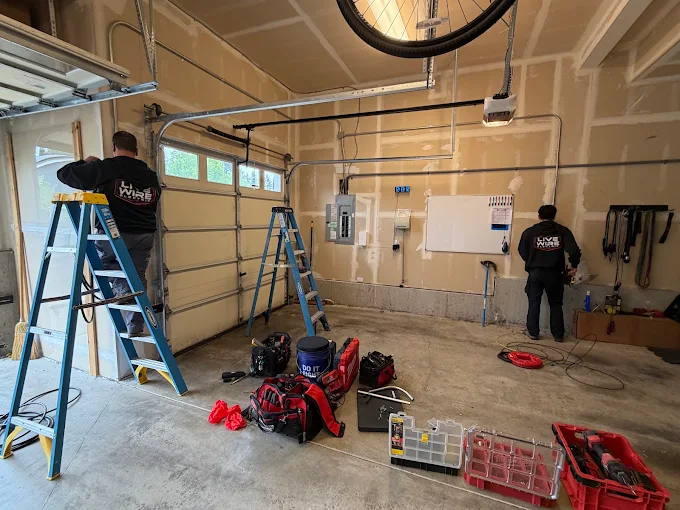
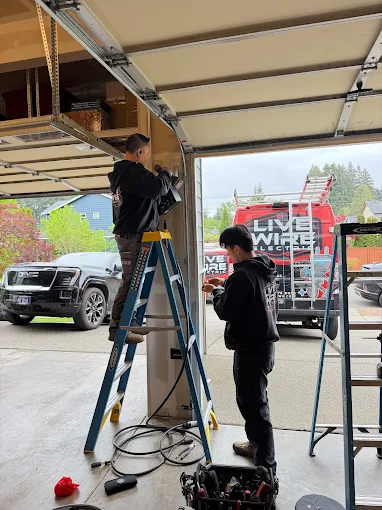
For context, Live Wire’s published project archive includes a September 2026 Bothell basement lighting and outlet installation. It documents ordinary residential outlet work, not an e-bike charging installation or a battery fire. Visit the individual story to see the project evidence rather than interpreting this article’s garage-wiring photograph as proof of a battery-specific job.
Reviews published on Live Wire’s site are attributed excerpts from customer feedback on broader electrical services, not a claim that a reviewer received an e-bike charger. The company’s reviews and recent-work archive offer separate ways to evaluate its published work.
For questions about garage outlets, circuits and wiring, call (206) 276-9029 or use the native Request Service control. The equipment manufacturer remains the source for replacement charger approval and battery repair, while a qualified electrician addresses the household electrical installation.
FAQs: charging, circuits and weather
Can I leave an e-bike charging outdoors during Pacific Northwest rain? Only when the manufacturer approves the specific weather conditions and equipment setup. Advice to charge large devices outdoors when practical does not authorize an indoor-only charger in the rain or a cord stretched through a wet doorway.
Does every e-bike charger require a dedicated circuit? No universal rule covers all consumer chargers. A professional should review the input rating, current loads and condition of the existing wiring before recommending new circuits.
Does a UL label mean there can never be a battery fire? No. Confirm that the appropriate complete product was certified by an accredited testing laboratory and continue following the manufacturer’s instructions. Stop using products that are damaged or subject to a safety warning.
Where should I take a swollen battery? Contact the local household hazardous-waste program and follow its handling instructions. Do not place damaged or recalled batteries in ordinary retail collection bins; if a device is actively smoking or burning, evacuate and call 911.
Helpful sources
Official guidance for a closer look.
- NFPA: 2026 Fire Prevention Week theme, October 4–10
- NFPA: large-device charging location safety
- CPSC: batteries and chargers for micromobility devices
- CPSC: September 2024 universal-charger warning
- Seattle Fire: signs of lithium-ion battery failure
- Electrical Safety Foundation: e-bike charging and extension cords
- Electrical Safety Foundation: outlet overload warning signs
- UL: UL 2849 and UL 2272 safety standards
- Snohomish County: residential recycling
- King County: household battery collection
- Washington Ecology: battery stewardship timeline
- Washington State Patrol: smoke and CO alarm guidance
From our crew to your home.
Live Wire Electric
We’re your Lynnwood-based electrical crew, helping homeowners understand their options and plan their next step.
Meet your local crewA good idea is better shared.