Share a little good energy.
Start with the energy you need each day
Write down your usual daily mileage, when the car arrives home and when it needs to leave. Include demanding days and whether another dependable charging option is available. Replacing a normal day's driving overnight is a different requirement from refilling an almost empty battery before a second long trip.
The Department of Energy notes that Level 1 charging can meet many drivers' daily needs when suitable equipment and a dedicated circuit are available. Level 2 offers faster charging and may better suit longer trips or shorter parking windows. Ask for an estimate using your actual vehicle and available charging time, rather than choosing the highest advertised output. Have an electrician assess an existing outlet and circuit before relying on them for regular charging.
Match the vehicle and the charging equipment
Give the installer the vehicle's year, model and charging manual, plus the exact charger you are considering. Confirm the connector, the vehicle's AC charging capability and any manufacturer-approved adapter arrangement. A connector that appears to fit is not enough to establish compatibility. Do not assume an adapter intended for public fast charging also works for home AC charging.
Charging speed depends on the car as well as the equipment and its installed settings. A larger charger cannot make the vehicle accept more AC power than it supports. Choose safety-certified equipment with clear installation instructions, a suitable indoor or outdoor rating, and support you can contact. Confirm which accessories are included before placing the order.
Have the electrical capacity assessed
An unused space in the panel does not establish available capacity. The electrician needs to assess the service, panel condition, existing loads and the proposed charging load. Tell them about electric heating, cooking, water heating and other equipment, along with planned changes such as a heat pump or second EV.
EV charging is treated as a continuous load, so the circuit and equipment settings require professional design under the applicable rules and manufacturer instructions. Ask to have the chosen charging output and the reason for it explained in the proposal. A 100-amp service does not automatically rule out charging, and a 200-amp label does not guarantee every desired load will fit.
Compare capacity options before assuming an upgrade
Where capacity is limited, ask whether a lower installed charging output or a supported load-management system could meet your needs. Tesla's Wall Connector documentation distinguishes a fixed output limit, dynamic adjustment using an approved power meter, and power sharing among compatible chargers. These are different functions with model-specific requirements.
A charging schedule is not the same as a system that monitors household demand and controls charging accordingly. Ask which equipment and configuration the proposal includes, what happens when other loads increase, and how much charging time to expect. Load management may change the installation options; it does not repair damaged equipment or guarantee that a service upgrade can be avoided.
Plan the parking position and cable route
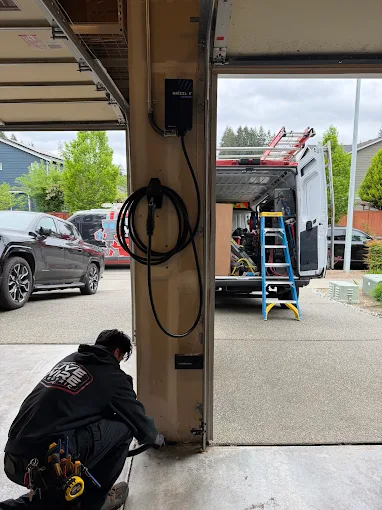
Park the car as you normally would and show where its charge port sits. Consider door swing, walking routes, garage storage and the other vehicle. The installed cable should reach comfortably without stretching across a doorway or being trapped beneath a garage door. Include a place to store the handle and cable.
Discuss the wiring route from the panel separately from the cable that connects to the car. Finished walls, masonry, a detached garage and driveway crossings can change access and restoration work. Ask what will remain visible and who repairs disturbed finishes. For outdoor charging, choose equipment rated for that location and follow its installation and operating limits.
Choose hardwired or plug-in for the actual model
Have the installer compare the manufacturer's permitted supply arrangements for the selected unit. A plug-in model needs the correct receptacle, circuit and protection; an existing dryer outlet is not automatically an appropriate charging connection. A hardwired model requires a permanent electrical connection. Outdoor suitability and required protection depend on the complete installation, not simply the presence of a plug.
Do not plan around extension cords or improvised adapters. Tesla's J1772 Wall Connector manual, for example, prohibits cord extensions and conversion adapters. Check the instructions for your own equipment rather than transferring assumptions from another product. If a unit or cable is damaged or repeatedly reports faults, stop using it and contact the installer or manufacturer.
Put permits and installation scope in writing
A new charging circuit requires an electrical permit and inspection. Confirm whether the address is served by L&I or a local electrical inspection jurisdiction. The contractor performing the electrical work obtains the required permit; ask who arranges inspection access and how the inspection fits before concealed work is covered.
Request a proposal identifying equipment, capacity assessment, wiring route, protection, configuration and any load-management hardware. Clarify whether utility coordination, wall repair, trenching or surface restoration is included. Ask what could change the price or sequence after assessment. A site-specific scope is more useful than a promise that every charger installation takes a few hours.
Finish with a charging demonstration and records
Ask the installer to explain the commissioned charging limit, normal indicator lights, cable care and what to do when charging stops. If the unit has an app, confirm account ownership and how schedules interact with the vehicle. Have supported load-management behavior explained too.
Keep the equipment manual, model and serial numbers, installation record and permit closeout information. Live Wire Electric can help plan home charging across King and Snohomish Counties, starting with your driving routine and electrical assessment. A useful handover leaves you knowing how to charge, what was installed and who to contact for help.
Helpful sources
Official guidance for a closer look.
- DOE guidance on charging at home
- DOE explanation of charging equipment and charging time
- Tesla's explanation of Wall Connector power management
- Tesla J1772 Wall Connector location considerations
- Tesla J1772 Wall Connector safety information
- Washington L&I electrical permit basics
- Find the electrical inspection jurisdiction
From our crew to your home.
Live Wire Electric
We’re your Lynnwood-based electrical crew, helping homeowners understand their options and plan their next step.
Meet your local crewA good idea is better shared.