Share a little good energy.
Start with the comfort you want
Decide where a breeze would help: over a seating area, in a bedroom or across a covered patio. Compare the manufacturer's room-size and airflow guidance, then consider noise preferences, appearance and whether the fan must also replace the room's main light.
A ceiling fan moves room air to help people feel cooler; it does not lower the room temperature or remove humidity like air conditioning. DOE recommends turning fans off when leaving a room if they are running for personal cooling. For winter circulation, follow the model's direction and speed guidance rather than assuming the summer setting suits both seasons.
Have the actual support checked
A light working normally overhead does not prove its box can support a moving fan. Give the electrician the fan's installed weight, including its light kit and accessories, plus the installation manual. They need to assess the attachment and structure as well as the electrical box.
Where the box carries the fan, it must be listed for fan support and suitable for the load. Some manufacturer-approved arrangements secure the fan directly to building structure with an approved electrical box for the connections. A heavy-fixture rating alone is not a fan-support rating; let the installer confirm the complete arrangement.
Separate a replacement from a new location
Replacing an existing light still calls for a wiring, grounding and support assessment. Tell the electrician whether you want separate fan and light control, and show every existing switch that operates the fixture. A remote may offer an approved control option, but it does not correct unsuitable wiring or support.
A new location adds route planning. Access above the ceiling, framing and the finished surfaces influence the work. Ask whether openings will be needed, who repairs them and how the new canopy will look against the ceiling. Avoid assuming that adding a fan always requires a new circuit—or that the nearest existing circuit is automatically suitable.
Check the complete installed height
Have the installer verify blade-to-floor, blade-to-wall and ceiling clearances against the selected manual and applicable requirements. Hunter's 3841-01 manual, for example, specifies at least seven feet below the blades and 30 inches from blade tips to the nearest wall or obstruction. Those figures do not replace the instructions for another model or settle every room's layout.
Account for the canopy, motor housing and any light beneath the blades when checking the finished drop. Show nearby beams, doors, bunk beds and raised landings. A low-profile model may help in a lower room; a taller room may need a compatible downrod to place airflow where it is useful.
Match the fan and hanging parts to the slope
Confirm that the exact fan is approved for an angled ceiling before shopping for an adapter. Low-profile fans and some other models are limited to flat ceilings. For compatible models, the permitted angle, canopy, mount and downrod requirements vary; a generic sloped-ceiling accessory is not assurance of a fit.
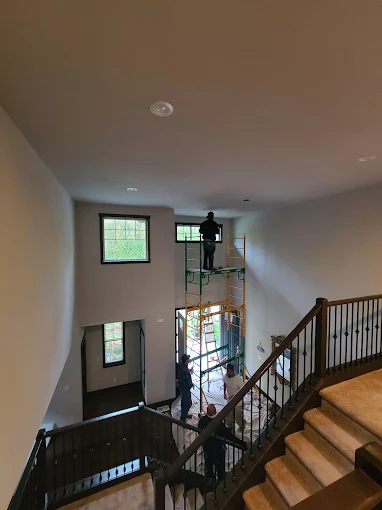
Ask the contractor to confirm the angle and approved parts, including any required extension wiring. On high ceilings or above stairs, include installation equipment and future cleaning or light-service access in the quote. Leave elevated measurements and equipment setup to the crew.
Choose the rating for the actual exposure
For a covered outdoor location protected from direct water, choose a fan rated for damp locations or an appropriate wet-rated model. Where rain or other direct water exposure can reach the fan, it needs the appropriate wet-location rating. Indoor-only equipment is not a substitute.
Describe wind-driven rain as well as the roof overhead. Have the installer check the fan, light kit, mounting arrangement and controls for their intended locations. Follow the product's care instructions; an outdoor rating does not make every cleaning method or replacement accessory suitable.
Choose controls for the exact fan
Do not use an ordinary lighting dimmer to control the fan motor or feed its remote receiver. Hunter explains that a wall dimmer can interfere with its fan controls. Even a fan-speed controller must match the model: AC motors, DC motors and integrated receivers can require different equipment.
Check compatibility by model number, including any exclusions on products labeled universal. Decide whether you want a wall control, handheld remote or smart features, and confirm light dimming separately. Include a convenient physical control for guests and everyday use.
Take new movement or noise seriously
If an existing fan develops pronounced wobbling, scraping or movement at its ceiling attachment, stop using it and arrange an assessment. The cause may involve mounting, assembly, damaged parts or blade balance. A balancing kit cannot make inadequate support acceptable.
At installation handover, ask the crew to demonstrate the available speeds and light settings. Raise unusual vibration or noise while they are there, and keep the manufacturer's cleaning and service instructions for later.
Agree on scope and handover
Ask for a written scope identifying the fan, support work, hanging parts, wiring, controls, access equipment and finish repairs. Your electrical contractor should confirm permit and inspection requirements for the address and work; Washington L&I requires hired contractors to obtain their own required permits. Before the visit ends, collect:
- The model number, manual, warranty information and agreed service contact.
- A demonstration of every control, including direction changes and any smart features.
- An explanation of any remaining inspection or finish work and who will complete it.
Helpful sources
Official guidance for a closer look.
- DOE: Energy Saver home-cooling guide
- Hunter: model-specific fan installation manual 3841-01
- Hunter: mounting styles and ceiling-slope guidance
- Hunter: damp and wet fan ratings
- Hunter: wall-dimmer and fan-control compatibility
- Hunter: universal control 99815 compatibility exclusions
- Washington L&I: electrical permits and inspections

From our crew to your home.
Live Wire Electric
We’re your Lynnwood-based electrical crew, helping homeowners understand their options and plan their next step.
Meet your local crewA good idea is better shared.