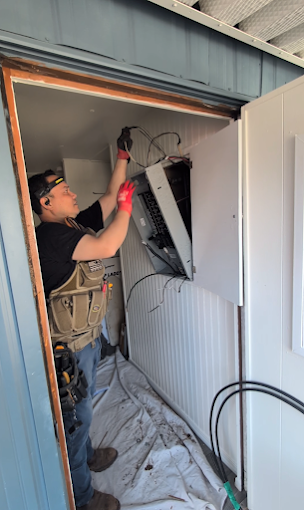
Share a little good energy.
Burning odors, damage or unusual sounds need prompt attention
Scorching, smoke, crackling, sparks or an electrical burning smell around a panel are warning signs. Keep people away and seek urgent professional help. Do not touch the enclosure to check its temperature, remove its cover or try operating suspect equipment. If there is smoke, fire or an immediate threat, leave and call 911 from outside.
CPSC identifies overheating, unusual sounds and odors as possible wiring hazards. An electrician must establish where the problem is and what equipment is affected. The remedy may involve connections, protective devices, wiring or damaged panel components. Replacing the box without understanding the cause is not a complete diagnosis.
Breakers keep tripping during ordinary use
Repeated tripping needs investigation, but it does not prove the entire service is overloaded. A problem can involve a particular circuit, connected equipment, a fault or a protective device. Schneider Electric's troubleshooting guidance distinguishes several possible causes.
Write down which rooms or equipment lost power and what was already running. Do not repeatedly reset breakers, increase a breaker rating or move a suspect appliance around to reproduce the problem. Ask the electrician whether the finding is local to a circuit or part of a broader capacity issue. Repairing a fault and planning additional electrical capacity are separate decisions.
Lights change across rooms or part of the home loses power
Unusual brightening, dimming or partial power loss calls for prompt attention, particularly when several rooms change together. Report these symptoms through your serving utility's outage or emergency channel and arrange an electrician's assessment. Do not approach a damaged meter, overhead connection or service cable.
Utility guidance distinguishes interruptions from voltage fluctuations and identifies service-connection problems among possible causes of partial power. A larger panel will not automatically correct an upstream supply problem. Tell the utility and electrician what you observed, including weather and whether neighbors were affected. Do not assume a recurring dip is harmless because it coincides with an appliance starting.
The equipment history is unclear or a safety notice may apply
An older panel, a fuse box or an unfamiliar brand deserves identification and a condition review. Age alone does not identify a defect, while an installation that still supplies power is not proof that its protection works properly. Gather prior reports and any safely visible labels; leave interior identification to the electrician.
Check a suspected recall against the exact product and production information. For example, CPSC's 2022 Schneider Electric recall concerns specified Square D QO Plug-on-Neutral load centers, with inspection and repair or replacement through the recall process. It is not a recall of every panel carrying that brand. Contact the manufacturer promptly if your equipment may be affected. A label photo can start that conversation, but cannot establish the panel's internal condition.
There is no obvious space for another circuit
A full panel raises a circuit-space question. It does not, by itself, measure the home's available electrical capacity. Conversely, empty spaces do not prove that the service can support another large load. Have the electrician evaluate both physical space and the electrical limits.
The manufacturer's labeling determines which breakers and circuit arrangements are permitted. Tandem breakers are not a universal way to add space; Schneider's guidance explicitly notes that acceptance depends on the load-center model. Ask whether an approved arrangement, a properly supplied subpanel or panel replacement fits the project. Additional breaker spaces alone do not increase the capacity of the utility service.
You plan to add charging, electric heat or other equipment
Provide the exact proposed equipment specifications and a list of existing major loads. A load assessment considers the home and its intended equipment together. Adding the amp numbers printed on individual breakers is not that assessment. Neither a 100-amp nor a 200-amp label answers every capacity question.
Seattle City Light distinguishes panel capacity, service capacity and the utility grid. Its guidance notes that a load study may show sufficient existing capacity or a need for changes. Ask whether suitable equipment choices or approved load management can meet your needs before assuming a service upgrade. These options depend on the installation; they do not repair damaged equipment or guarantee that an upgrade can be avoided.
A remodel or addition changes how the home will use power
A project is a good time to resolve electrical questions before cabinets, finishes or landscaping limit access. Give the electrician appliance selections, room plans and the expected construction sequence. Include likely future projects, while distinguishing definite equipment from possibilities.
Ask which circuits need to change, what can remain and whether any panel or service work is actually necessary. Remodeling does not automatically require replacing the panel. Early assessment helps coordinate the work; it cannot establish a universal cost saving or completion date. Clarify responsibility for wall repairs, trenching and utility applications before comparing estimates.
Compare repair, panel replacement and service upgrade scopes
A useful proposal states the finding and the remedy. Repair addresses an identified fault. Panel replacement changes distribution equipment. A service upgrade changes supply capacity and can require coordinated utility and customer-side work. These scopes can overlap, but a new panel alone does not create a larger utility supply.
Panel replacement and service work require electrical permits and inspection. The contractor obtains the permit for its work. Confirm the inspecting authority, required utility disconnect/reconnect arrangements, outage sequence and any grounding, bonding or related corrections included. Snohomish County PUD provides separate service-change and disconnect/reconnect processes. Keep the completed circuit directory, written scope and inspection records, and have normal protective-device operation explained before the job is closed.
Helpful sources
Official guidance for a closer look.
- CPSC: home wiring hazards and warning signs
- Schneider Electric: possible causes of breaker tripping
- FPL: interruptions, voltage changes and partial power
- CPSC: the specific 2022 Square D QO recall
- Schneider Electric: tandem breakers and load-center compatibility
- Seattle City Light: capacity, load studies and service planning
- Washington L&I: electrical permit responsibilities
- Snohomish County PUD: service changes and disconnect/reconnect planning
From our crew to your home.
Live Wire Electric
We’re your Lynnwood-based electrical crew, helping homeowners understand their options and plan their next step.
Meet your local crewA good idea is better shared.